
For about two years, every hard training day ended the same way. I would hit leg day or a long trail run, come home, eat, shower, and be in bed by 9:30. I was tired enough to fall asleep in minutes. Then at some point around 3 AM I would just be awake. Eyes open. Heart rate slightly elevated. Mind starting to spin through nothing in particular. I would lie there for an hour, maybe ninety minutes, finally drift back off, and then the alarm would go off at 6. I would get up feeling like I had not really slept at all.
I chalked it up to being in my forties. I told myself it was stress from work. I bought a nicer mattress. I cut caffeine after noon. I tried one of those magnesium oxide supplements I found at the drugstore, took it for two weeks, felt nothing, and gave up on the whole idea. The 3 AM wake-up became such a fixture in my life that I started setting my recovery expectations around it. I planned for two bad recovery days after every hard session instead of one. I stopped doing back-to-back hard days because I knew I would not have the juice for it.
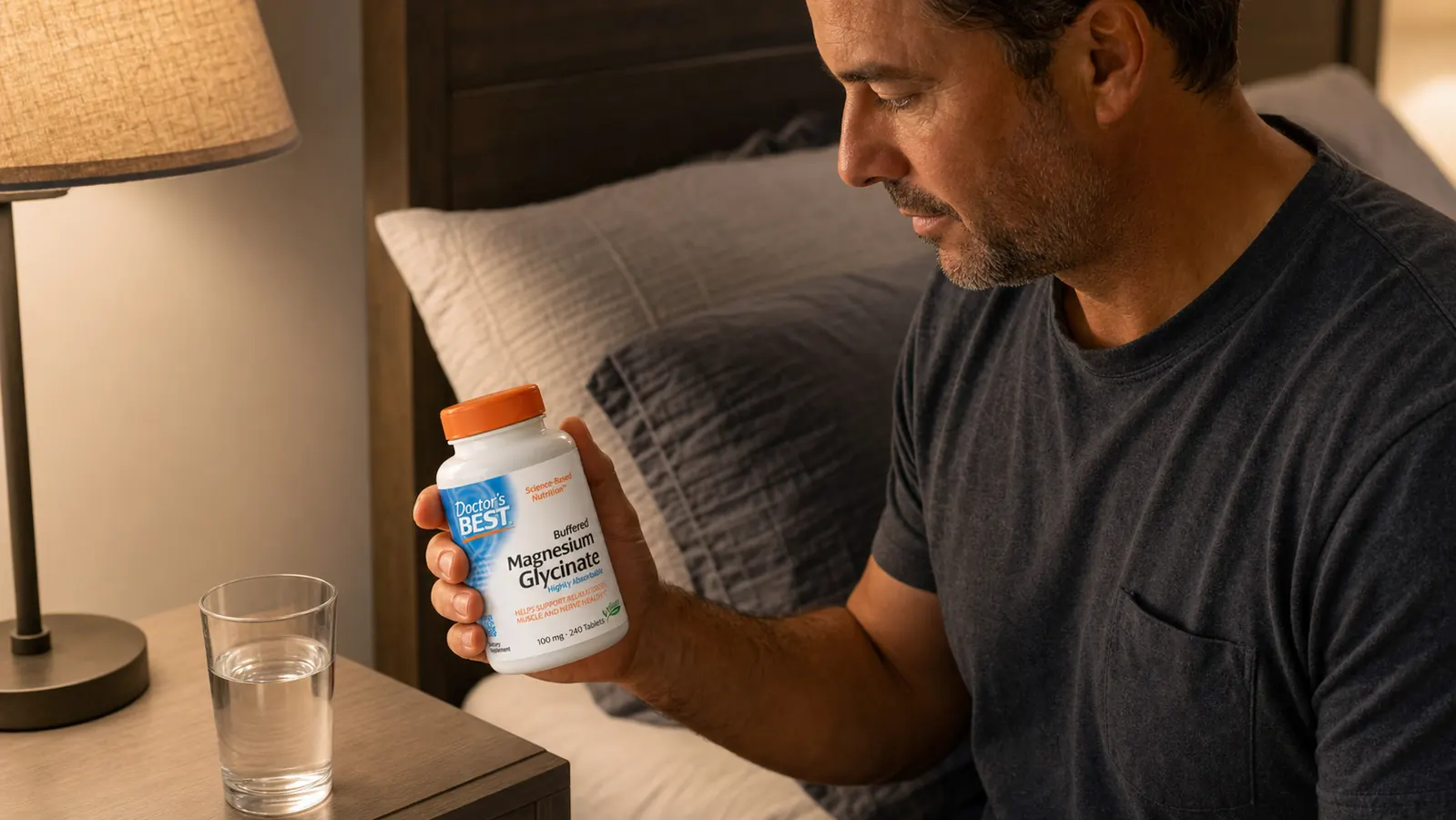
Then a guy at my gym mentioned he had been using Doctor's Best High Absorption Magnesium Glycinate for about four months and that his sleep had changed noticeably. Not dramatically, he said. He did not wake up a new man. He just stopped waking up at 3 AM. That was the whole story. I filed it away and forgot about it for a few weeks.
I stopped waking up at 3 AM. That was the whole story. Four words that described the thing I had been chasing for two years.
What eventually got me to try it was reading about why hard training wrecks sleep in the first place. When you put your body through a heavy squat session or a two-hour trail run, cortisol spikes to manage the effort. That spike is supposed to fall off as you cool down and eat. But in some people, especially as you get into your late thirties and forties, that cortisol curve stays elevated longer than it should. You fall asleep fine because you are genuinely exhausted. But around 2 or 3 AM, when blood sugar is dropping and your nervous system is still slightly activated, you surface out of deep sleep and your brain decides it is time to be awake.
Magnesium plays a role in regulating the nervous system and supporting the transition into deep, slow-wave sleep. Most people who train hard are running low on it because sweat depletes magnesium faster than most people replace it. The glycinate form specifically is chelated, meaning it is bound to the amino acid glycine, which makes it absorb better than the oxide or citrate versions and is less likely to cause the digestive issues that keep people from sticking with cheaper forms.
If the 3 AM wake-up is wrecking your recovery, this is the exact supplement I use.
Doctor's Best High Absorption Magnesium Glycinate. 200mg per serving, chelated for absorption, 240 tablets. Rated 4.6 stars across more than 75,000 reviews. I take two tablets about 45 minutes before bed.
Amazon Check Today's Price on Amazon →
I ordered a bottle and kept expectations low. I had been burned by the oxide version. I started with two tablets about 45 minutes before bed, the way the label suggested. The first night I noticed nothing dramatic. The second night I fell asleep and did not remember waking up until the alarm. I assumed that was a fluke. The third night was the same. By the end of the first week I had slept through the night five out of seven nights. After two weeks it was a consistent thing. The 3 AM wake-up was just gone.
My soreness also improved in a way I did not expect. Leg day used to leave me stiff for two full days, a 7 out of 10 on the first morning and still a 4 or 5 on the second. After a month on the magnesium glycinate I was waking up after a hard session at more like a 4, and by day two I was back to normal. Whether that is the sleep or the magnesium itself working on muscle function, I honestly cannot say. Probably both. The point is that training stopped feeling like it was eating me alive between sessions.
I have been on it for about five months now. The one thing I will say honestly is that it is not magic. On nights when I am genuinely stressed about something or I had alcohol, the sleep is still worse. It is not a sleeping pill. It is more like it removes a barrier that was there because my body was depleted of something it needed. When that deficiency is corrected, the sleep that was supposed to happen after hard training actually happens.
What I'd Tell You If We Were Sitting at My Kitchen Table

If you are training hard and consistently waking up in the middle of the night, especially in that 2 to 4 AM window, I would not tell you to spend money on a new mattress or a sleep tracker. I would tell you to try magnesium glycinate for thirty days first. Not the oxide version from the drugstore. The glycinate form, chelated for absorption. Doctor's Best is the one I use because it has a real dose at 200mg per serving, a clean ingredient list, and it is affordably priced for a 240-count bottle, which is a four-month supply at two tablets a night. The math on that is easy to justify.
Give it three weeks before you decide. The first few nights may not feel different. By week two you will have enough data to know if it is doing something. If you are anything like me, the thing you will notice first is not that you slept better. It is that you stopped waking up. Sometimes recovery fixes are not dramatic. They are just the removal of something that was quietly in the way.
For the full breakdown on how magnesium glycinate works and how to time the dose around training, read the 90-day review with sleep tracking data. And if you want to understand what else is in a solid nighttime recovery stack, the 10 reasons magnesium glycinate helps athletes recover covers the research without the fluff.
Two tablets. Forty-five minutes before bed. Four months of supply at a budget price.
That is the whole protocol. Doctor's Best High Absorption Magnesium Glycinate is the one I have used consistently for five months. Chelated form, no fillers, over 75,000 ratings on Amazon.
Amazon Check Today's Price on Amazon →