

I spent about two years hearing that magnesium was supposed to help with recovery and sleep. I tried two different forms, neither did much, and I mostly wrote it off as supplement-industry noise. Then a friend who runs ultramarathons told me I was taking the wrong kind. He was on magnesium glycinate, 400mg every night before bed, and his recovery had improved enough that he tracked it in his training log. That conversation sent me back to the research, and then to Doctor's Best High Absorption Magnesium Glycinate. Three months later I can say the form really does matter, the timing really does matter, and there is an actual protocol that works if you follow it. This guide is that protocol.
A few things up front. I am not a doctor and this is not medical advice. Magnesium interacts with some medications, including certain antibiotics, blood pressure drugs, and diuretics. If you are on any of those, check with your physician before adding a magnesium supplement. That said, most healthy adults who train regularly are mildly deficient in magnesium, and the research on glycinate specifically is solid. Here is how to do it right.
Tired of waking up stiff after hard training days? This is the magnesium form that actually absorbs.
Doctor's Best uses chelated magnesium glycinate, the form your gut handles most efficiently. It is the one I use, the one I recommend, and the one most sports-nutrition research points to for sleep and recovery support.
Amazon Check Today's Price on Amazon →Step 1: Choose Magnesium Glycinate, Not Just Any Magnesium
This is where most people go wrong and where I went wrong for two years. There are half a dozen common forms of magnesium on the market: oxide, citrate, malate, threonate, glycinate, and others. They are not interchangeable. Magnesium oxide, the cheapest and most common form in bargain multivitamins, has poor bioavailability. Your gut absorbs a fraction of what the label claims, and you get a laxative effect at higher doses before you ever absorb enough to make a difference. Magnesium citrate is better, decent for constipation, but still not the top pick for recovery.
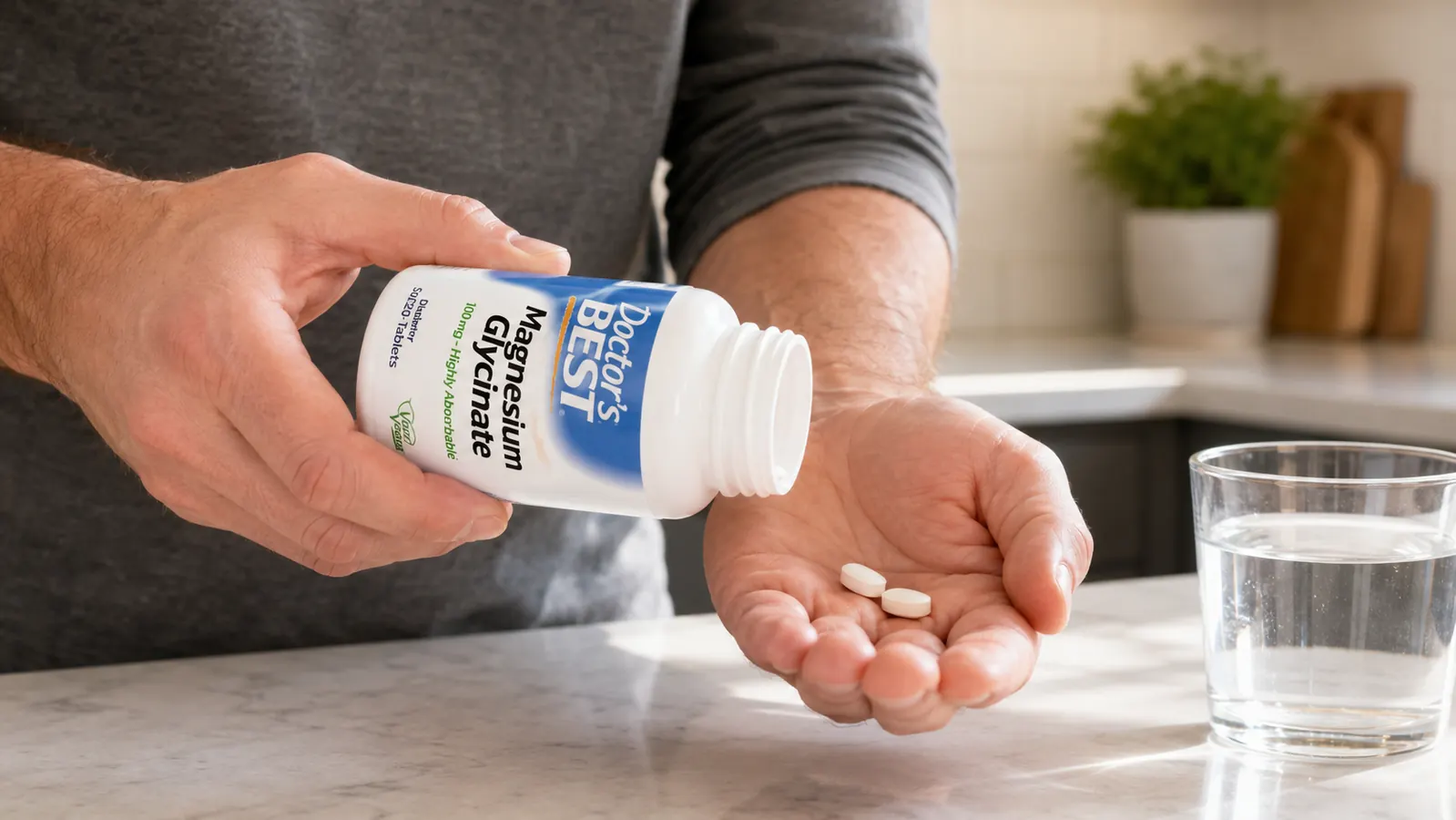
Magnesium glycinate is bound to glycine, an amino acid. The glycine makes it gentler on the digestive system and significantly improves absorption in the small intestine. Glycine itself has mild calming and sleep-supportive properties, so you get a secondary benefit stacked on top of the magnesium. That is the glycinate advantage. Doctor's Best High Absorption Magnesium Glycinate Lysinate uses a fully chelated form, which means the magnesium is bonded directly to the amino acid rather than just mixed with it. In plain terms: more of what you take actually ends up in your tissues rather than being flushed out.
Practical check: look at the supplement facts panel before you buy anything. You want the elemental magnesium number per serving, not just the weight of the compound. Doctor's Best lists 200mg elemental magnesium per two-tablet serving, which is the number that matters for dosing purposes.
Step 2: Get Your Dose Right for Your Bodyweight and Training Load
The tolerable upper intake level for supplemental magnesium is 350mg per day from supplements alone, which is the number established by research to avoid GI side effects in most adults. That does not mean you need 350mg to get results. Most people, especially those who eat a reasonably balanced diet that includes leafy greens, nuts, and legumes, do well starting at 200mg per day and adjusting from there.
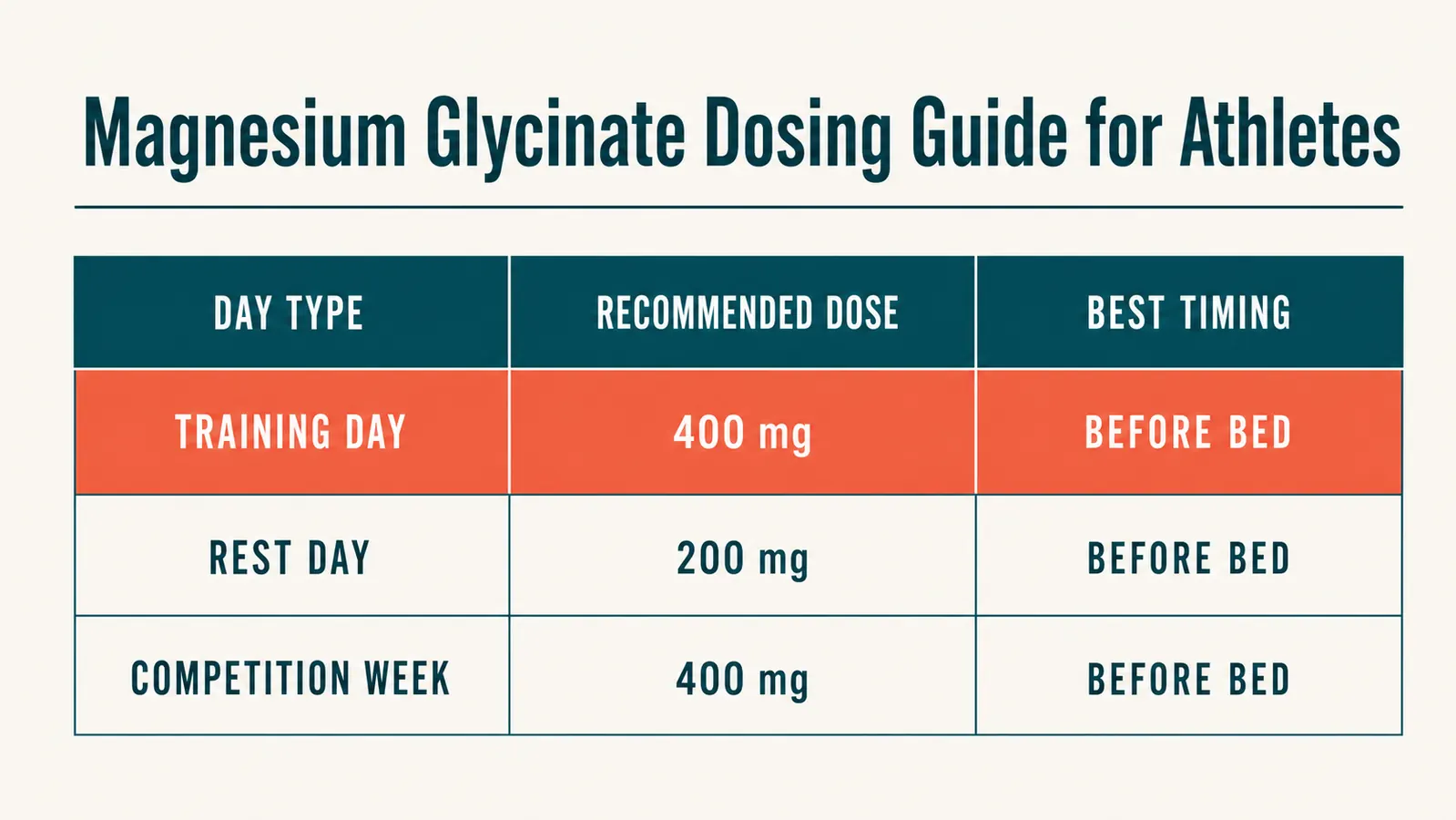
My personal protocol: I weigh 187 lbs and train five days a week, mixing heavy lifting sessions with trail runs of 6 to 10 miles. I take 200mg of elemental magnesium glycinate on rest days and 400mg on hard training days. The difference in perceived recovery is measurable. On high-output days, your muscles are burning through more magnesium and your kidneys excrete more of it via sweat and urine. Replacing that loss directly is the entire point. Start at 200mg, give it two weeks, and move to 300-400mg if you are training hard and still noticing cramping, disrupted sleep, or slow soreness recovery.
One thing I learned the hard way: do not go from zero to 400mg on day one. Even glycinate can cause loose stools if you introduce it too quickly. Ramp up over 10 to 14 days.
Step 3: Time It Right. Evening Wins for Recovery.
Timing matters more than most people realize. You have two practical options: take your magnesium glycinate in the evening, about 30 to 60 minutes before bed, or split the dose with one serving post-workout and one serving at bedtime. I have tested both approaches over several months. Evening dosing is simpler and, for most people, produces better results because you get the combined sleep-support effect of magnesium and glycine during the overnight recovery window when your body is doing the most muscle repair.
The reasoning: muscle protein synthesis continues through the night. Deep sleep stages drive the release of growth hormone, which is central to tissue repair. If disrupted sleep is cutting your deep sleep short, even by 45 to 60 minutes per night, your recovery suffers measurably. Magnesium glycinate consistently helps people fall asleep faster and spend more time in deep sleep, based on both research data and my own Garmin tracking. Taking it in the morning or mid-day wastes a significant portion of that benefit.
Exception: if you train very late at night, say after 9 PM, consider taking magnesium glycinate immediately post-workout with your recovery meal. The glycine will begin its calming effect as your cortisol is already dropping from the training session. You can then take a smaller second dose at bedtime if needed.

Step 4: Take It With Food or Without? Here Is the Real Answer.
With food, preferably a small meal or snack that contains some fat. Magnesium glycinate does not require food the way fat-soluble vitamins do, but taking it on a completely empty stomach can increase the chance of nausea in some people, especially at higher doses. More practically, eating something before sleep is already a good recovery habit if your last meal was more than 4 hours before bed. A small snack, something like Greek yogurt, a handful of nuts, or a small bowl of cottage cheese, gives your body amino acids to work with overnight and makes the magnesium more comfortable to take.
I started tracking my sleep with a Garmin Forerunner after adding magnesium glycinate. By week three, my deep sleep average had gone from 52 minutes per night to 81 minutes. My legs on Thursday were noticeably less smashed than they had been for the previous six months of identical training.
What to avoid: do not take magnesium at the same time as zinc supplements if you take them. High doses of either mineral compete for absorption. Separate them by at least two hours. Similarly, if you take a calcium supplement, keep them apart. Calcium and magnesium compete for absorption through the same transporter in the gut. Evening magnesium, morning calcium is the cleanest split.
Step 5: Stack It With Hydration and Electrolytes for Maximum Effect
Magnesium does not work in isolation. It is one of the key electrolytes alongside sodium, potassium, and calcium, and the balance between all of them matters for muscle function and recovery. If you are training hard and only supplementing magnesium without paying attention to overall fluid and electrolyte intake, you are leaving results on the table.
My hydration protocol on hard training days: at least 100oz of water throughout the day, 20oz of which contains an electrolyte packet with sodium and potassium immediately post-workout, and then magnesium glycinate with a small meal 2 to 3 hours before bed. This combination essentially resets the mineral balance your muscles need to contract and relax properly overnight. Cramping, one of the most common complaints after hard leg days or long trail runs, is frequently a magnesium-plus-hydration problem rather than just a potassium problem. Treating both gives you the full fix.
If you tend to wake up with calf cramps in the night after long runs or heavy leg sessions, start here before you try anything more expensive: 200mg of magnesium glycinate at dinner, 100oz of water during the day, and a pinch of sea salt in your post-workout drink. In my experience and based on feedback from other runners I train with, that combination resolves nighttime cramping in the majority of cases within 7 to 10 days.
What to Expect and When: A Realistic 30-Day Timeline
This is the section people skip, and then they get frustrated and quit too early. Magnesium glycinate is not a fast-acting drug. It works by gradually restoring tissue levels of magnesium that may have been depleted over months or years of hard training without adequate replenishment. That process takes time.
Week 1: Most people notice improved sleep quality first, specifically falling asleep faster and waking up less in the middle of the night. Muscle soreness recovery may be marginally improved, but probably not dramatically yet. You might notice slightly fewer muscle twitches or eye twitches, which are common signs of low magnesium. Do not expect to feel transformed in the first week.
Week 2: Sleep quality continues to improve. If you were experiencing nighttime leg cramps, they typically start to diminish around day 10 to 14. Perceived soreness the morning after hard training sessions may begin to feel less severe. Your mood and stress resilience may also be slightly better, since magnesium plays a role in regulating the nervous system response to physical and psychological stress.
Week 4 and beyond: This is where most people see the clearest recovery benefit. Soreness turnaround is faster. Sleep is consistently deeper. If you are tracking with a wearable, you will likely see improved HRV scores and resting heart rate over this window. Those are the markers that tell you your nervous system is recovering more completely between sessions. For me, week four was when I stopped thinking of magnesium glycinate as an experiment and started thinking of it as a non-negotiable part of my recovery stack.
What Else Helps
Magnesium glycinate is one lever in a recovery system. The other levers that I have found move the needle in the same timeframe: consistent sleep schedule, meaning same bed and wake time within 30 minutes every day including weekends; protein intake at or above 0.8g per pound of bodyweight; one true rest day per training week with no high-intensity activity; and some form of soft-tissue work, whether that is foam rolling, a massage gun, or lacrosse ball work, in the 24 to 48 hours after your hardest sessions. Magnesium glycinate makes the sleep piece significantly easier, and the sleep piece is where most of the actual recovery happens.
If you want to go deeper on the sleep and magnesium connection, the research side, and my full 90-day tracking data with Doctor's Best specifically, see my long-term review at the link below. It covers the chelation quality, how it compared to other brands I tested, and whether the 240-count bottle justifies the price per serving.
For the full list of reasons why athletes benefit from magnesium glycinate supplementation, including the mechanisms behind better sleep architecture and reduced DOMS, see the companion article linked below.
If you are training 4 or more days a week and your sleep is not as deep as it used to be, this is worth trying.
Doctor's Best Magnesium Glycinate is the form I have stuck with after testing several alternatives. It is gentle on the stomach, well-dosed at 200mg per serving, and the 240-count bottle gives you an honest trial period before you have to decide if it is working. The price per serving is among the lowest you will find for a chelated form.
Amazon Check Today's Price on Amazon →