
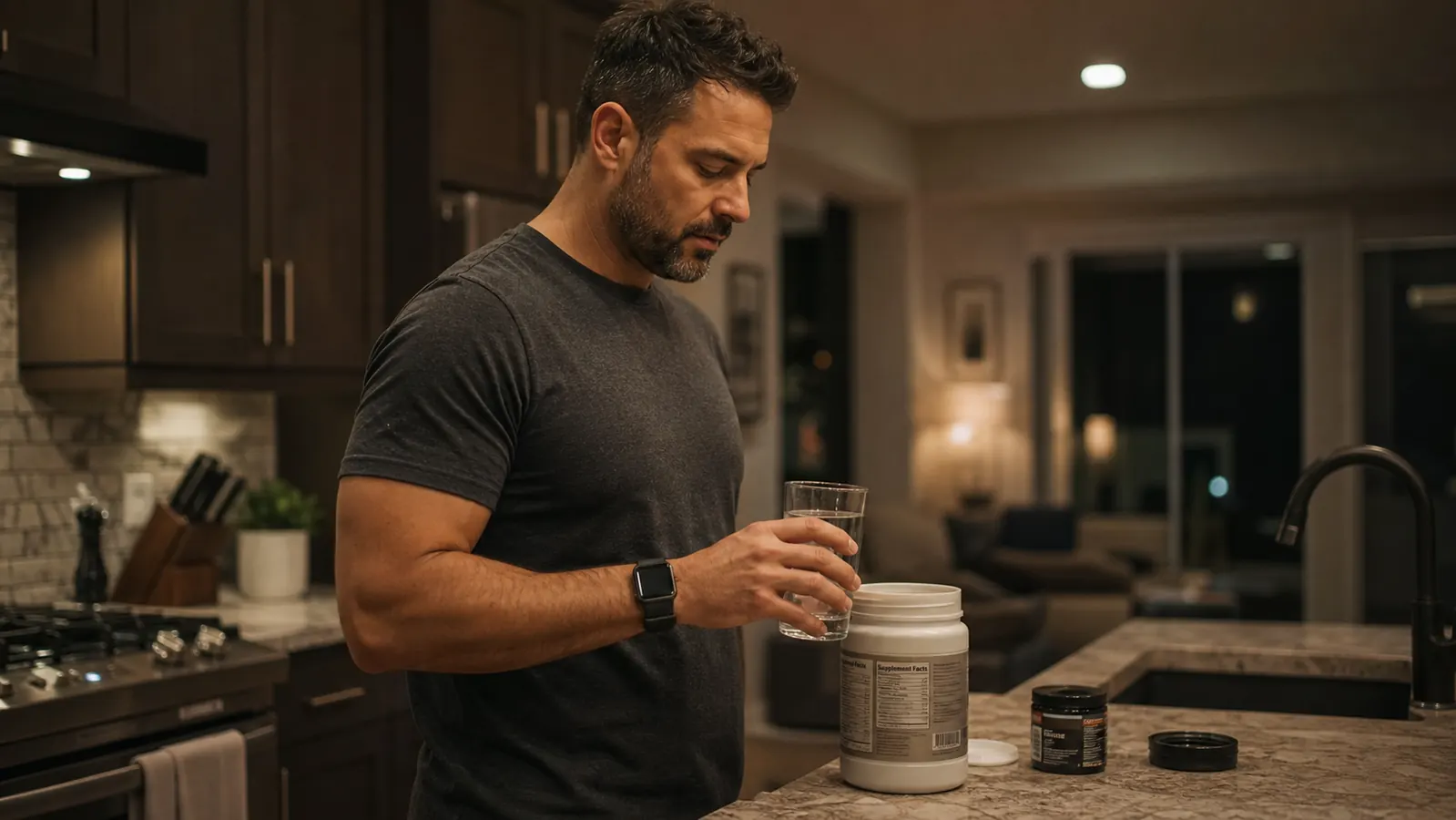
Let me start with something most magnesium supplement reviews skip entirely: the pills are big. Not inconveniently big, but bigger than the standard capsule you might be used to. Doctor's Best High Absorption Magnesium Glycinate Lysinate comes in oval tablets, and the serving size is four of them to hit 200mg of elemental magnesium. Four. Every night. That is the first thing nobody mentions in the glowing five-star reviews, and it matters if you are already taking a stack of other supplements before bed.
I am Marcus. I have been training in my garage gym for about eight years, running trails on weekends, and using this particular bottle of magnesium glycinate for the past six months. I also used it for three months before that, stopped for a month to see if anything changed, and then restarted. I want to give you the honest version: who this actually helps, who notices zero difference, and what the fine print looks like when you are not just reading the label for the first time.
The Quick Verdict
Solid chelated magnesium from a brand with real third-party testing. The dose math works out well, but four tablets a night and occasional loose stools at higher doses are real trade-offs most reviews gloss over.
Amazon Check Today's Price →If you train hard and sleep badly, this is the cheapest experiment worth running.
Doctor's Best Magnesium Glycinate is budget-friendly for 240 tablets, that is a 60-day supply at the full four-tablet dose. If magnesium depletion is behind your recovery issues, you will know within three to four weeks. Check today's price on Amazon before you order a cheaper oxide version that barely absorbs.
Amazon Check Today's Price on Amazon →How I Actually Used It (Not How the Label Recommends)
The label says two to four tablets daily. I went straight to four because I train five days a week and I knew from basic research that athletes burn through magnesium faster than sedentary people. I took all four about 45 minutes before bed, which is where most of the magnesium-for-sleep conversation lands. I did not split the dose morning and night, even though some practitioners recommend that. I wanted to isolate the sleep variable, not spread it across the day.
Three months in I dropped to two tablets to test the low end. Here is what I noticed: sleep quality felt roughly the same, muscle cramping during long runs came back a little, and the GI comfort was noticeably better. The four-tablet dose had been giving me soft stools about two or three nights a week, which is mild but real and worth flagging if your gut runs sensitive. Two tablets fixed that completely. I ended up settling on three tablets nightly, which is not a standard dose option but is, apparently, allowed.
The Pill Reality Nobody Posts in a Review
Here are the actual tablet dimensions: roughly 20mm long and 8mm wide. That is a standard large oval tablet. Nothing dramatic, but if you are swallowing four at once you will want a full glass of water, not a sip. I have not had trouble with them, but my training partner swallowed two at once on his first night and had that stuck-tablet sensation for a while afterward. Start with one or two at a time if you are pill-averse.
The 240-count bottle sounds like a lot until you realize that is only 60 days at the full four-tablet dose, or 80 days at three tablets. If you order once and forget, you will run out faster than you expect. Set a reminder or subscribe. Doctor's Best also does not offer a powder version of this specific glycinate lysinate formula, so if you prefer powders you are looking at a different brand entirely.

Is It Placebo? Being Honest About the Evidence
This is the question I spent real time on. Because here is the truth: I cannot prove that the improvements I noticed in sleep and muscle cramping were caused by magnesium glycinate and not by some other variable I changed during the same period. I was also sleeping better because I stopped having coffee after noon, and my cramping improved in part because I increased hydration on long run days. Magnesium glycinate probably contributed. I cannot tell you by how much.
What the research actually says is reasonable but often overstated by supplement marketers. Magnesium plays a role in muscle contraction and nerve function. A genuine deficiency, which is more common in hard-training athletes than the general population, is associated with poorer sleep quality and increased muscle cramps. If you are deficient, supplementing can help. If you are not deficient, the evidence for benefit is much weaker. Most people buying this supplement do not know whether they are deficient. I do not know if I was. That uncertainty is real and worth sitting with.
I cannot tell you magnesium glycinate fixed my sleep. I can tell you that after I stopped taking it for a month, my sleep got noticeably worse on hard training weeks. That is the closest I have to an honest answer.
Who Actually Notices a Difference
In my experience across conversations with other lifters and runners who have tried this, the people who notice the clearest benefit fit a specific profile: they train four or more days per week, they sweat heavily, they do not eat many leafy greens or nuts, and they have been dealing with either middle-of-the-night waking or nocturnal leg cramps. That combination suggests a real magnesium gap. For those people, this supplement is often genuinely useful within two to four weeks.
The people who notice nothing tend to have a different profile: they eat a reasonably varied diet, they train three days or fewer per week, and their sleep issues trace back to stress, screen time, or inconsistent schedules rather than mineral depletion. Magnesium is not a sleep drug. It does not sedate you. If your sleep problem is behavioral rather than physiological, this bottle will not solve it.
Why Glycinate Specifically, and Whether Cheaper Forms Are Good Enough
There are at least seven common forms of magnesium supplements on the market. Magnesium oxide is the cheapest and the worst absorbed. Studies suggest it absorbs at roughly 4% bioavailability. Magnesium citrate absorbs better but hits the GI tract hard at higher doses, which is why it is used as a laxative. Magnesium glycinate binds the magnesium ion to glycine, an amino acid, which escorts it through the intestinal wall more efficiently. The glycine also has its own mild calming effect, which is one reason glycinate has a reputation for sleep support that oxide does not.
Doctor's Best uses a chelated form called TRAACS from Albion Minerals, which is the same chelation technology used in some clinical-grade supplements. That is a meaningful detail. A lot of brands claim glycinate on the label but use a cheaper blend that does not chelate properly. The Albion TRAACS certification is third-party verified and appears on the Doctor's Best label. It is not marketing language.
What Goes Wrong at Higher Doses
I mentioned the soft stool issue at four tablets nightly. Let me be specific about that. It was not diarrhea. It was not painful. It happened roughly every two to three days, not every day. But if you have a client meeting in the morning or a race day coming up, you want to know that high-dose magnesium, even glycinate, can still produce some GI looseness. Start at two tablets and work up over two weeks. Do not go straight to four on night one just because the label says that is a serving.
There is also the glycine load to consider. At four tablets you are getting roughly 1200mg of glycine from the glycinate complex in addition to the magnesium. Glycine is generally safe and actually has its own mild sleep-promoting data behind it. But if you stack this with a collagen supplement, which also delivers glycine, you are taking in a notable amount of that amino acid at bedtime. That is probably fine, but it is worth being aware of if you are a systematic supplementer.
What the Alternatives Look Like at This Price Point
Pure Encapsulations Magnesium Glycinate is the other brand serious supplement users mention most often. It costs roughly twice as much per serving, uses a different chelation process, and is aimed at clinical and medical practitioner markets. The quality is comparable or marginally better in some independent tests. Whether the price premium is worth it depends entirely on your budget. Doctor's Best is not a budget brand cutting corners. It is a legitimate mid-tier supplement using real chelation technology. For most athletes spending their own money, Doctor's Best is the call. I cover the full Doctor's Best vs Pure Encapsulations comparison in a separate piece if that decision matters to you.
The cheap option to avoid is any magnesium oxide marketed as magnesium glycinate with fine print about a blend. Read the Supplement Facts panel carefully. If the form listed is magnesium oxide or magnesium citrate and the label says glycinate in large print, that is a label integrity problem. Doctor's Best lists the form as magnesium glycinate lysinate chelate (TRAACS) clearly in the Supplement Facts. No sleight of hand.
What I Liked
- Albion TRAACS chelation is third-party verified, not just a label claim
- Glycinate form is genuinely easier on the GI tract than oxide or citrate at the same dose
- 240-count bottle is practical value for consistent daily use
- Vegan, gluten-free, no unnecessary fillers in the formula
- Noticeable benefit for athletes with genuine magnesium depletion from heavy sweating
- The low price makes it one of the cheapest legitimate chelated magnesium options available
Where It Falls Short
- Four-tablet serving size is cumbersome if you take other nighttime supplements
- Soft stool side effect is real at the full four-tablet dose for some people
- Tablets, not capsules or powder, which limits flexibility for sensitive swallowers
- No benefit if you are not actually magnesium deficient, and most buyers do not know
- 60-day supply sounds long but goes fast if you never skip a dose
Who This Is For
Heavy sweaters who train four or more days a week and eat a diet that does not include a lot of magnesium-rich whole foods. Runners who get nocturnal leg cramps, especially in the calf and foot, that are not explained by hydration alone. Lifters in their late thirties or older who have noticed that sleep quality has degraded on hard training weeks in a way that does not track with stress or caffeine. People who want a supplement from a brand that uses real chelation chemistry and posts their testing process publicly. If that profile sounds like you, the odds of noticing a genuine benefit are reasonable.
Who Should Skip It
People who already eat a diet heavy in almonds, spinach, pumpkin seeds, dark chocolate, and whole grains are probably getting adequate magnesium from food. People whose sleep problems are driven by anxiety, irregular schedules, or screen exposure will not get a fix from a mineral supplement. Anyone with kidney disease should not supplement magnesium without talking to their doctor first, as kidneys regulate magnesium excretion and impaired function changes the risk profile significantly. And if you hate swallowing large tablets and have no interest in powders from a different brand, this format is going to frustrate you every night.
For more context on where this fits in a broader recovery supplement approach, the breakdown on the top reasons magnesium glycinate helps athletes is worth reading before you order.

Six months in, I still have it in my nightstand. That is the real verdict.
Doctor's Best Magnesium Glycinate uses verified chelation technology, absorbs meaningfully better than oxide forms, and costs budget-friendly for a 60-day supply. If you are going to experiment with magnesium, start with the form that actually absorbs. Check today's price on Amazon before you end up with a cheaper oxide blend that barely makes it through your gut.
Amazon Check Today's Price on Amazon →